News Center
Contact us
Company Address:
Huangtuan Industrial Park, Renmin East Road, Zhucheng City, Shandong Province
Phone:+86-13356766511
E-mail:zcbwkj@163.com
Web:www.zcbwkj.com
Split conveyor belt
Release time:
2024-12-10
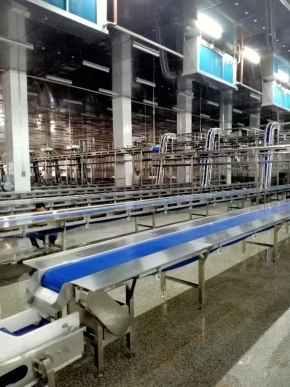
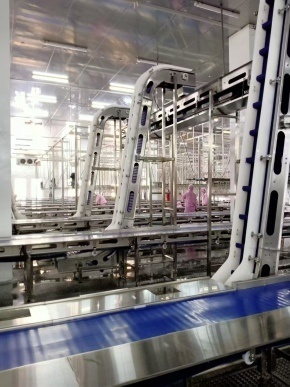
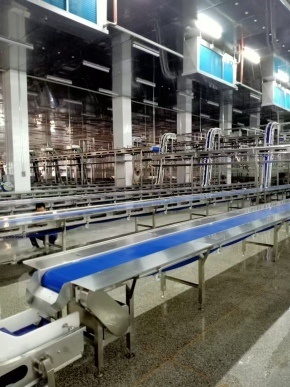
An overhead split conveyor is a logistics system that uses belt conveyors at high altitudes to divide goods and transport them from one location to another. The following is a detailed analysis of the overhead split conveyor:
### I. Definition and Functions
The high-altitude split conveyor combines the functions of high-altitude conveying and cargo splitting, enabling precise segmentation and positioning of goods during the conveying process, thereby meeting the specific handling requirements of various industries. It is commonly used in large logistics centers, factories, terminals, and other similar facilities to enhance logistics efficiency and improve the accuracy of cargo handling.
### 2. Structural Composition
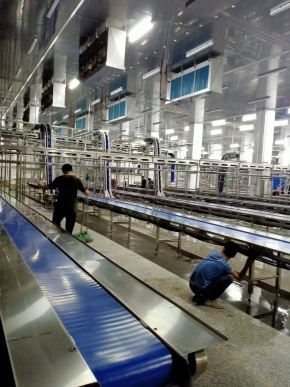
The high-altitude split conveyor belt mainly consists of the following components:
1. **Conveyor Belt**: As the core equipment of the system, it is used to carry and transport goods. Depending on the different characteristics of the goods and specific conveying requirements, conveyor belts can be made from various materials and have different structures, such as ordinary conveyor belts, loop conveyor belts, and wire-rope conveyor belts.
2. **Drive Unit**: Provides the power to drive the conveyor belt’s operation. The drive unit typically includes components such as a motor, a reducer, and a transmission mechanism.
3. **Dividing Device**: A dividing device should be installed on the conveyor belt to divide goods during the conveying process. The design of the dividing device should be determined based on the characteristics of the goods and the specific dividing requirements.
4. **Support Frames and Counterweights**: These are used to support the weight of the conveyor belt and the conveyed goods, ensuring the system’s stability and safety. The support frames typically feature steel or aluminum alloy structures, while the counterweights are employed to balance the tension in the conveyor belt.
5. **Monitoring System**: Real-time monitoring of the operation status of the high-altitude segmented conveyor belt and the segmentation of goods, ensuring the system operates normally and goods are safely handled.
### 3. Working Principle
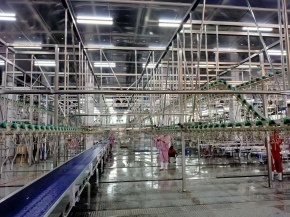
The working principle of the high-altitude split conveyor belt is as follows:
1. **Drive Unit Activation**: When the drive unit is activated, it sets the rotating shaft in motion, which in turn drives the conveyor belt to rotate continuously via friction.
2. **Cargo Conveyance**: The cargo is placed on a conveyor belt and transported to the designated location as the belt moves.
3. **Cargo Segmentation**: During the transportation process, the segmentation device precisely divides the cargo to meet specific processing requirements.
4. **Cargo Unloading**: The segmented cargo is unloaded onto a designated area at the end of the conveyor belt.
### IV. Application Fields
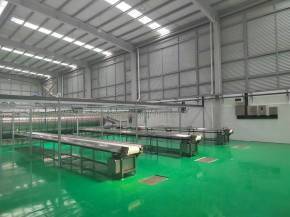
High-altitude split conveyor belts are widely used in the following fields:
1. **Logistics Industry**: Used for sorting, packaging, and transporting goods in large-scale logistics centers.
2. **Manufacturing**: Used for material handling and segmentation on production lines.
3. **Food Industry**: Used for portioning during the processing, packaging, and transportation of food products.
4. **Pharmaceutical Industry**: Used for segmentation during the packaging, sorting, and transportation of pharmaceutical products.
### V. Strengths and Features
1. **Efficiency**: The high-altitude conveyor belt can significantly enhance logistics efficiency and the accuracy of cargo handling.
2. **Flexibility**: The speed of the conveyor belt, the position of the dividing device, and other parameters can be flexibly adjusted according to the characteristics of the goods and the conveying requirements.
3. **High degree of automation**: Remote monitoring and automated control are achieved through a monitoring system, reducing labor costs.
4. **High Security**: The system features a stable architecture and incorporates security protection measures to ensure the safety of both goods and personnel.
In summary, high-altitude conveyor belts play a vital role in modern logistics and manufacturing. They can enhance logistics efficiency, reduce labor costs, and ensure the safety of goods, making them indispensable equipment for related industries.
Key words:
Related News
Design Proposal for a Hand-Torn Chicken and Duck Production Line to Enhance Productivity
The design scheme for a hand-torn chicken and duck processing line aimed at boosting production efficiency has become a focal point of attention in the modern food-processing industry, particularly in the fast-paced catering market, where enhancing production efficiency is a goal pursued by every enterprise. Against this backdrop, the design scheme for a hand-torn chicken and duck processing line has gradually drawn significant industry attention. Such a line not only accelerates production speed but also ensures product quality, meeting consumers’ demand for fresh and delicious flavors. So, how can we design an efficient hand-torn chicken and duck processing line? Next, we’ll explore this topic. First, let’s take a look at the basic components of a hand-torn chicken and duck processing line. Typically, such a line comprises several key stages: raw material preparation, preliminary processing, shredding, seasoning, and packaging. At each stage of the production line, rational layout and appropriate equipment selection are crucial. Imagine this processing line as a symphony—each stage is like an instrument; only when these instruments work together seamlessly can they produce a captivating melody. Now, let’s talk about how to optimize the design of the hand-torn chicken and duck processing line. First and foremost, equipment selection is critical. For instance, during the shredding stage, using a specialized shredding machine can not only ensure uniform shredding but also...
2025-11-24
Five Strategies to Boost the Production Capacity of Cantonese Roasted Meat and Charcuterie Lines
The Five Strategies for Boosting the Production Capacity of Cantonese Roasted Meat Lines In today’s fiercely competitive foodservice market, Cantonese roasted meat production lines have become a core component for many catering businesses. While ensuring delicious flavors remains paramount, how to enhance production efficiency and capacity has become a crucial challenge that every operator must address. Today, let’s talk about how to boost the production capacity of Cantonese roasted meat lines through five key strategies. Strategy One: Optimize the Production Process Imagine this: You’re bustling around in the kitchen, yet you always feel overwhelmed and disorganized. Optimizing your production process is like adding a clear map to your workflow. First, clearly define the responsibilities of each stage—such as marinating, roasting, and slicing—ensuring that every step runs efficiently. By eliminating unnecessary steps, you can significantly speed up production. Specifically, you can use flowcharts to help employees understand the importance of each stage, making sure everyone is in the right position and minimizing time wasted. Have you ever experienced delays caused by insufficient preparation of ingredients? After optimizing your processes, such situations will be greatly reduced. Strategy Two: Introduce Advanced Equipment If you’re still using traditional ovens to prepare Cantonese roasted meats, it might be time to consider investing in some modern equipment. Advanced equipment not only boosts production efficiency but also ensures...
2025-11-14


Company Address:
Huangtuan Industrial Park, Renmin East Road, Zhucheng City, Shandong Province

Phone website