
Shandong Baowei Poultry Feather Removal Machine
- Commodity name: Shandong Baowei Poultry Feather Removal Machine
- Detailed description
-
# Poultry Feather Removal Machine: A Highly Efficient Solution Driven by Technological Innovation
The poultry slaughter and processing industry is undergoing a critical transition from traditional manual methods toward intelligent and automated operations, with technological breakthroughs in the head feather removal stage playing a particularly crucial role. As a core component of poultry depilating equipment, the head feather removal machine utilizes the synergistic effects of mechanical friction and centrifugal force to efficiently remove feathers from the heads of birds such as chickens, ducks, and geese. This technology not only addresses the longstanding issues of low efficiency and significant hygiene risks associated with traditional manual plucking but also drives the industry toward standardization and large-scale production.
## Technical Principles and Structural Innovations
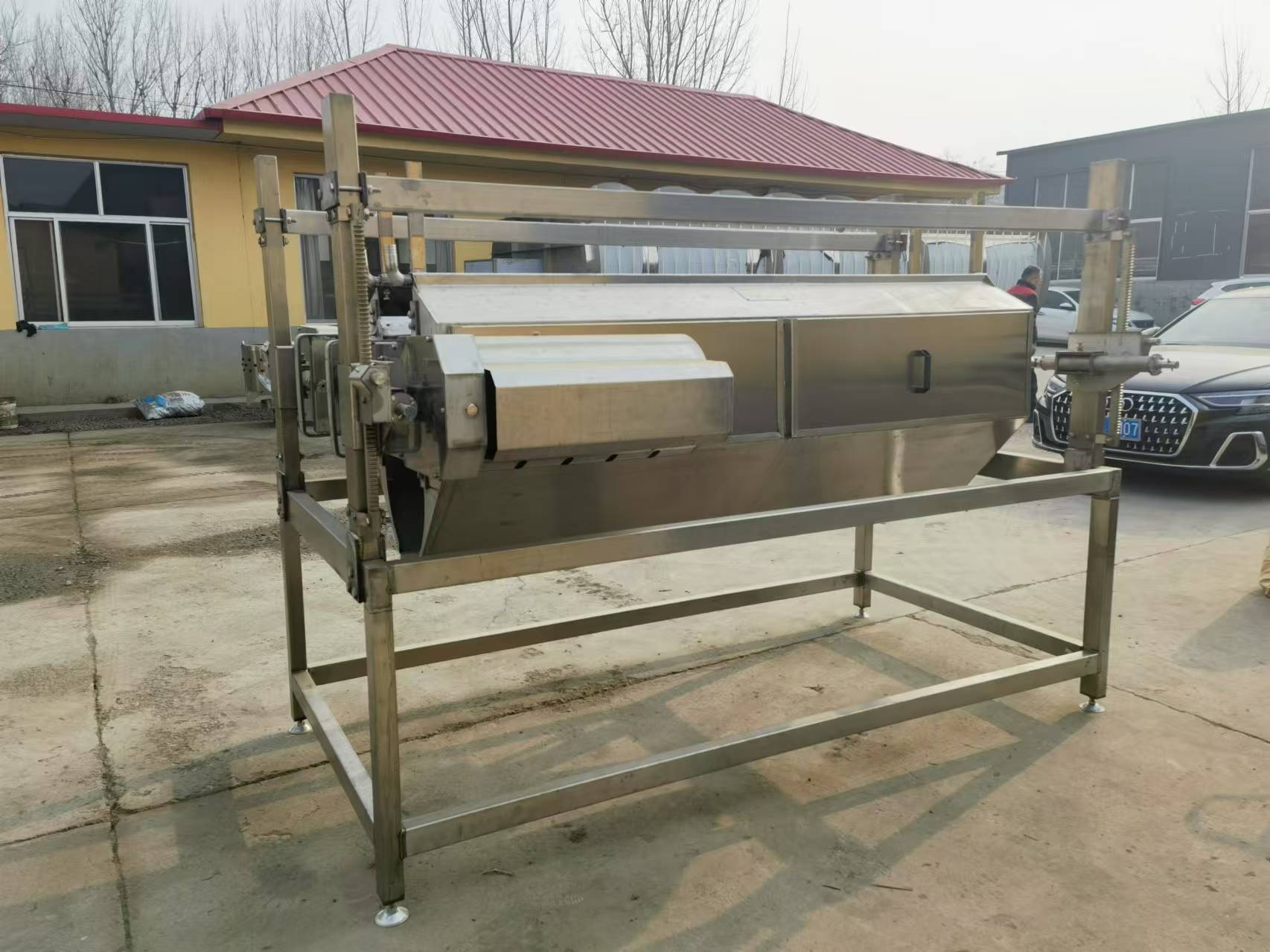
The modern head-feather removal machine features a dual-drum cross-layout design. Its core components include wear-resistant rubber depilatory rods, an adjustable-speed motor assembly, and an intelligent temperature-control system. Once the poultry heads enter the depilation chamber, the upper and lower sets of drums rotate at high speed in opposite directions. The depilatory rods, thanks to their elastic deformation, penetrate deep into the base of the feathers, using frictional force to remove the feathers from the skin surface. Take, for example, a seven-axis vertical depilation machine developed by a company in Zhucheng City: its depilation rollers are made of food-grade silicone with a 360-degree spiral pattern on their surface. The machine can perform up to 200 friction strokes per minute, ensuring that the feather removal rate for even hard-to-process areas such as duck heads reaches over 98%.
Equipment innovation is reflected in three key dimensions: First, the power system has been upgraded—featuring a dual-motor configuration with pure copper components, enabling each unit to deliver a power output exceeding 6 kW, a 40% improvement over conventional models. Second, the design adopts a modular approach: the depilating unit can be independently disassembled and cleaned, making it adaptable to the processing needs of different types of poultry. Third, intelligent temperature-control technology uses a PID controller to precisely maintain the scalding water temperature between 65°C and 70°C, thereby preventing meat quality deterioration caused by excessively high temperatures. The A-shaped depilating machine launched by Shandong Huate Machinery further integrates an AI-powered visual recognition system that can automatically identify the physical characteristics of poultry and dynamically adjust the depilation force and duration parameters accordingly.
## Market Applications and Efficiency Breakthroughs
In large-scale farms and central kitchen settings, head-feather removal machines demonstrate significant advantages. Take, for example, a slaughtering line operated by Guangdong Wen's Group: after adopting a fully automatic scalding and feather-removal integrated machine, the daily processing capacity increased from 3,000 birds to 12,000 birds, while labor costs were reduced by 65%. Equipment operation data show that each kilowatt-hour of electricity can be used to pluck feathers from 180 poultry, representing an 82% reduction in energy consumption compared to manual operations. For breeds with abundant subcutaneous fat, such as geese, Jiangsu Xin Nong Machinery has developed a flexible gripping mechanism that uses pneumatic pressure adjustment to achieve stepless control over plucking force, keeping the damage rate for goose heads below 0.3%.
The market segmentation is characterized by differentiated competitive dynamics. Small- and medium-sized farms tend to opt for rechargeable handheld depilators priced between 3,000 and 8,000 yuan. These devices are powered by lithium-ion batteries and can operate continuously for up to four hours on a single charge, perfectly meeting the needs of home-based processing operations. In contrast, large-scale slaughtering enterprises prefer integrated production-line systems costing over 200,000 yuan—for instance, the vertical seven-roller depilator manufactured by Tuhe Machinery in Zhucheng City. This equipment is equipped with an automatic flipping and discharging mechanism, capable of processing 450 poultry per hour. Moreover, its depilation wastewater can be recycled, ensuring compliance with environmental protection standards.
## Industry Trends and Challenges
Technological iteration is driving the reshaping of market dynamics. According to MRFR data, China's poultry plucking machine market reached 4.5 billion yuan in 2023, with automated equipment accounting for 60% of the market. This segment is expected to surpass 6 billion yuan by 2025. At the policy level, the "National Development Plan for the Livestock and Poultry Slaughtering Industry" explicitly requires that by 2025, the adoption rate of automated equipment among large-scale enterprises should reach 85%, directly generating a replacement demand for existing equipment worth 354 billion yuan. Enterprises are focusing their innovation efforts on three key areas: First, IoT integration—using sensors to monitor the wear level of plucking rollers in real time, enabling predictive maintenance that reduces equipment downtime by 40%; second, energy-saving technologies—adopting permanent-magnet synchronous motors to cut energy consumption by 30%; and third, material innovation—employing nano-coating technology to extend the service life of plucking rods to over two years.
However, the industry’s development still faces multiple challenges. Fluctuations in raw material prices directly affect manufacturing costs; in 2024, the price of stainless steel sheets rose by 18%, causing some enterprises to see their gross profit margins shrink by 3.2 percentage points. Meanwhile, export markets are encountering technical barriers—upgrades to the EU’s CEMD directive have increased the certification cost per piece of equipment by 12,000 yuan. Moreover, uneven regional market development has become a prominent issue: the East China and South China regions account for 58% of the market share, while equipment penetration rates in the central and western regions remain below 30%, presenting new opportunities for industry expansion.
## Future Outlook
With the development of an ecosystem featuring "intelligent equipment + IoT platform + value-added services," poultry feather-plucking machines are evolving from standalone devices into comprehensive system solutions. By 2030, it is projected that the connectivity rate of these devices will exceed 75%, and the share of aftermarket service revenue will rise to 18%. Emerging markets such as Southeast Asia and Africa are demonstrating strong growth potential, with export volumes expected to expand at an average annual rate of 12%. In this technological transformation, companies that master core patents and possess flexible manufacturing capabilities will dominate the market—for instance, Shandong New Hope Liuhe Machinery has already established 10 overseas after-sales service centers, providing global customers with a 72-hour response time.
From manual plucking to intelligent hair removal, each technological leap in the poultry processing industry has profoundly impacted food safety and industrial efficiency. The head-feather removal machine, as a microcosm of this transformation, not only addresses the pain points of traditional methods but also drives value enhancement across the entire industry chain through continuous innovation. Driven by both market demand and technological breakthroughs, this specialized segment is now writing a new chapter in the development of modern agricultural equipment.
Key words:
Shandong Baowei Poultry Feather Removal Machine
Get Quote


Company Address:
Huangtuan Industrial Park, Renmin East Road, Zhucheng City, Shandong Province
Phone website